
How to Earn Urgent Care CME With the Rosh Review Urgent Care Qbank

Related Articles



If you work in urgent care, you already know the job is defined by its range. In a single shift, you might drain an abscess, splint an ankle, talk a worried parent through caring for a febrile toddler, and read your own point-of-care ultrasound all before lunch. No two patients look alike, and the next one is always waiting.
That breadth is exactly what makes urgent care rewarding. It’s also what makes staying current so difficult. The conditions you see don’t fit neatly into a single specialty’s CME, and most credit-earning options weren’t designed for the way you actually practice.
That’s the gap the Rosh Review Physician Urgent Care Qbank was designed to fill. And it’s a straightforward way to keep your knowledge sharp while earning urgent care CME. Here’s what’s inside, how it works, and how you turn your questions into credit.
What Is the Urgent Care Qbank?
The Rosh Review Physician Urgent Care Qbank is a >300-question, case-based question bank built for the clinician on the front lines of undifferentiated, walk-in care. While it falls under Rosh Review’s family medicine umbrella, it was written for the urgent care setting rather than just one specialty.
Whether you trained in family medicine, emergency medicine, internal medicine, or pediatrics and now spend your shifts in urgent care, the content maps to the patients coming through your door.
We built it because urgent care clinicians kept telling us the same thing: the existing resources don’t reflect their scope. Board-prep material from a single specialty either goes too deep in one area or skips the bread-and-butter procedures and decision points that define an urgent care shift. Clinicians want something that covers the actual differential of a busy clinic and that helps them earn urgent care CME without having to carve out extra time they don’t have.
The Qbank spans the full urgent care landscape, including:
1. Skin, Soft Tissue, and Procedures
This includes abscess incision and drainage, cellulitis, wound care, and laceration repair.
2. Musculoskeletal and Orthopedics
This includes sprains, fractures, low back pain, and concussion evaluation.
3. Point-of-Care Ultrasound
This includes soft tissue, first-trimester, and focused applications you can use at the bedside.
4. Respiratory and Infectious Disease
Pneumonia, pharyngitis, mononucleosis, influenza, and asthma exacerbations are included in this section.
5. Genitourinary
This includes UTIs and sexually transmitted infections.
6. ENT, Dental, and Ophthalmology
Dental trauma, epistaxis, and red eye are included in this section.
7. Dermatology
This includes any rashes you are expected to recognize on sight.
8. Environmental and Toxicology
Bites, burns, foreign bodies, and common overdoses are part of this block.
9. Special Populations
These are cases spanning from pediatrics to geriatrics.
As you can probably surmise, the throughline is practicality. Every case is one you could plausibly see this week as an urgent care clinician.
Inside the Urgent Care Qbank: What You Actually Get
Rosh Review questions are known for having a particular feel—they’re clinically realistic, board-style, and built to teach as much as they test. The Urgent Care Qbank has all of these features.
It contains the following:
Case-Based, Single-Best-Answer Questions
Each item opens with a realistic clinical vignette (a patient, a history, an exam, often vital signs) and asks you to make the same decision you’d make in the room. Rather than memorizing isolated facts, you’ll be reasoning through management.
Images & Illustrations
The Qbank includes hundreds of visuals (POCUS clips and stills, radiographs, dermatologic photos, and custom medical illustrations) so you’re interpreting the same kind of data you rely on clinically, not just reading about it.
Explanations That Teach the Whole Concept
This is where a Rosh Review question earns its keep. Every answer comes with a thorough explanation of why the correct choice is correct, the underlying pathophysiology and evidence, and the practical technique or decision points. Just as important, every distractor gets its own rationale so you learn why the tempting wrong answers are wrong.
Current, Cited References
Each question is backed by references to authoritative sources so you can trust the content (and go deeper when you want to).
Performance Tracking
As you work through the Qbank, you can see your strengths and weaknesses in each content area, so your study time goes where it matters most.
A Sample Question from the Urgent Care Qbank
Here’s a representative case from the Qbank so you can see the format for yourself:
A 30-year-old man presents with an ankle injury after he twisted his ankle when stepping off the curb. The patient mainly reports pain near the right lateral malleolus. Which of the following examination findings would be more indicative of an ankle sprain that would not require further diagnostic imaging?
A. Bony tenderness in the malleolar zone
B. Bony tenderness in the midfoot zone
C. Inability to bear weight on the ankle
D. Swelling over the lateral malleoli
Correct Answer: D
The most common type of ankle injury is an ankle sprain to the lateral ankle. Typically, these are minor and are due to an inversion injury. Sprains are categorized into three grades. Grade I involves no tearing of the ligaments with minimal functional loss, pain, swelling, and ecchymosis. Weight-bearing is tolerable. Grade II sprains occur with a partial tear and some loss of functional ability. They tend to be more painful, with swelling, ecchymosis, and difficulty bearing weight. Grade III sprains result from a complete tear, with significant functional loss, pain, swelling, and bruising, and an inability to bear weight.
The Ottawa Ankle Rules are frequently used by physicians and nurses to determine the likelihood of a fracture versus a sprain and the need for imaging. Swelling over the lateral malleoli is a common finding in ankle sprains. This finding, particularly without other bony tenderness in a patient who is able to bear weight, is more indicative of an ankle sprain and would not make a physician more suspicious for an ankle fracture. In patients with a lateral sprain and the ability to bear weight, treatment consists of analgesics, an elastic bandage or ankle brace, and no sport involvement with follow up in a week if no improvement.
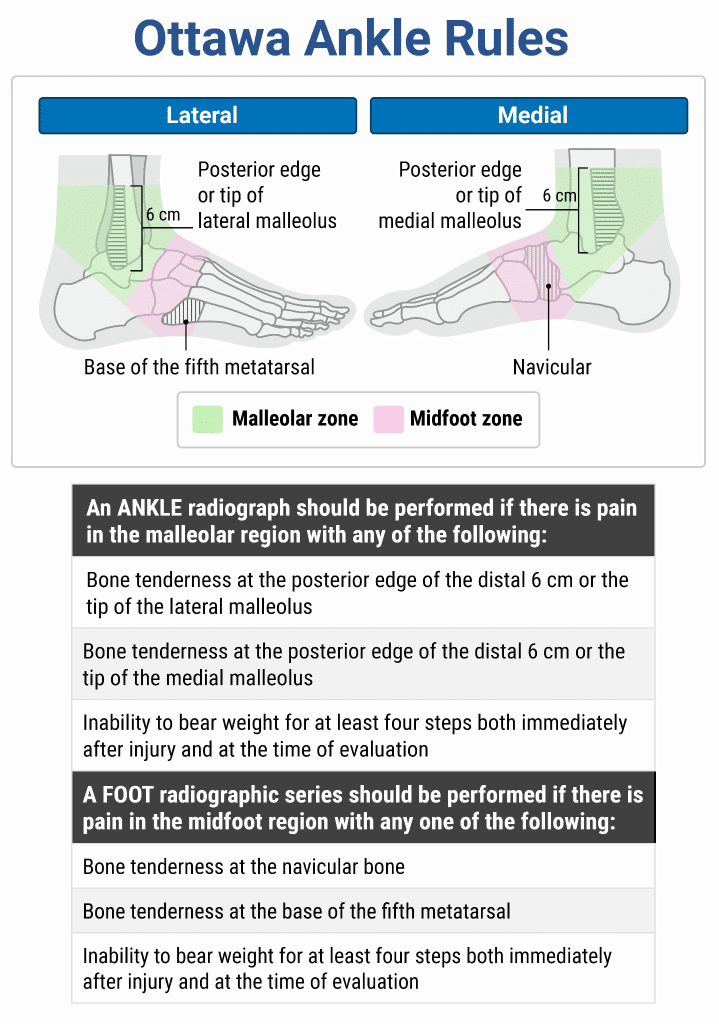
The Ottawa Ankle Rules were originally developed for patients > 18 years old who were able to cooperate, were not intoxicated, and had no distracting injuries or decreased sensation. Patients with bony tenderness over the malleolar zone (A), bony tenderness over the midfoot zone (B), or an inability to walk four steps in the emergency department (C) should be considered to have a more serious injury and potentially a fracture. These patients require further diagnostic imaging with radiography.
How to Earn Urgent Care CME with Your Qbank Access
Here’s the part that makes this more than just great study material: your Qbank subscription is also a CME engine.
The Urgent Care Qbank is accredited to offer 30 AMA PRA Category 1 Credits™, which means the studying you’d do anyway now counts.
The workflow is simple:
- Subscribe to the Urgent Care Qbank.
- Work through the questions at your own pace—on the couch, between patients, or in short sessions on your phone.
- Claim your credit directly within the platform as you complete the accredited activity, and download or print your certificate for your records and your licensing or credentialing requirements.
There’s no separate course to buy, no live event to attend, and no extra step to remember. You learn something useful for your next shift, and you get to earn urgent care CME while you do it! It’s a far more efficient way to meet your requirements than passively sitting through content that doesn’t reflect your practice.
See it for yourself!
Explore the Urgent Care Qbank →
The Bottom Line
Urgent care asks you to be ready for almost anything. The Urgent Care Qbank was built to match that reality: > 300 realistic, image-rich, thoroughly explained questions across the conditions you actually see, from clinicians who understand the setting. Best of all, it turns the time you spend staying sharp into urgent care CME you can claim and count.
If you’ve been looking for a smarter way to keep current and knock out your credits, this is it!
And for more (free!) content to help you along your medical journey, check out these other posts on the blog:
- How a Commitment to Lifelong Learning Will Make You a Better Physician
- Inclusive Language for Medical & Health Education: An Evolving Guide
- The Greatest Mindset Shift You Can Make as a Physician
Rosh Review is a board review company providing Qbanks that boost your confidence for your boards and beyond. Get started with a Rosh Review free trial to the Qbank of your choice (no credit card required!) and gain access to board-style practice questions, detailed explanations, beautiful medical images, and more.


Comments (0)